> For the complete documentation index, see [llms.txt](https://docs.higiocloud.vn/llms.txt). Markdown versions of documentation pages are available by appending `.md` to page URLs; this page is available as [Markdown](https://docs.higiocloud.vn/hi-gio-user-guide-vn/hi-gio-draas/stretching-layer-2-networks-cho-hi-gios-draas/chuan-bi-cau-hinh.md).

# Chuẩn bị cấu hình

## <mark style="color:green;">Quy trình</mark> <a href="#id-2.-guidance" id="id-2.-guidance"></a>

{% stepper %}
{% step %}

#### Bước 1: Điền thông tin vào các ô màu vàng. <a href="#step-1-please-fill-in-the-formation-in-yellow-cells" id="step-1-please-fill-in-the-formation-in-yellow-cells"></a>

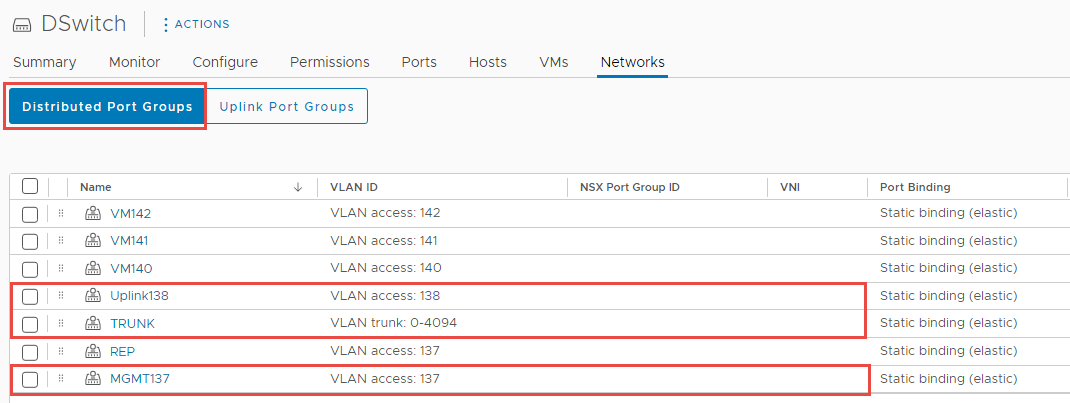
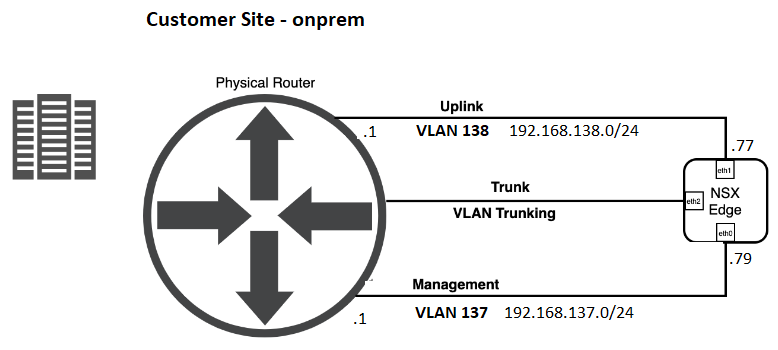
* VLAN & Port groups sẽ được tạo trên vDistributed Switch.

| **#** | **Port Group** | **VLAN**                                                    | **Remark**                         |
| ----- | -------------- | ----------------------------------------------------------- | ---------------------------------- |
| 1     | Management     | 1<mark style="background-color:yellow;">37</mark>           | For NSX Autonomous Edge management |
| 2     | Uplink         | <mark style="background-color:yellow;">138</mark>           | For NSX Autonomous Edge uplink     |
| 3     | Trunk          | <mark style="background-color:yellow;">140, 141, 142</mark> | Stretch L2 network traffic         |

* Cài đặt mạng cho NSX Autonomous Edge.

<table data-header-hidden data-full-width="false"><thead><tr><th></th><th></th><th width="286"></th><th></th><th></th><th></th></tr></thead><tbody><tr><td>#</td><td>OVF Template Name</td><td>Port Group</td><td>Primary Node</td><td>Second Node (optional)</td><td>Remark</td></tr><tr><td>1</td><td>Network 0</td><td>Management</td><td><mark style="background-color:yellow;">192.168.137.79</mark></td><td><mark style="background-color:yellow;">192.168.137.80</mark></td><td> </td></tr><tr><td>2</td><td>Network 1</td><td>Uplink</td><td><mark style="background-color:yellow;">192.168.138.77</mark></td><td>–</td><td>must to have access to internet</td></tr><tr><td>3</td><td>Network 2</td><td>Trunk</td><td>–</td><td>–</td><td> </td></tr><tr><td>4</td><td>Network 3</td><td>– (HA, optional)</td><td><mark style="background-color:yellow;">192.</mark>1<mark style="background-color:yellow;">68.137.81</mark></td><td><mark style="background-color:yellow;">192.168.137.82</mark></td><td> </td></tr></tbody></table>

&#x20;

<figure><img src="https://content.gitbook.com/content/dOZ82gj0wvhbAUlxBHpj/blobs/KIguOmH92wODiGv6l4W7/image.png" alt=""><figcaption><p>NSX Autonomous Interfaces</p></figcaption></figure>

* Địa chỉ Public IP:

| On-premises Public IP                                       | HI GIO's Public IP                                          |
| ----------------------------------------------------------- | ----------------------------------------------------------- |
| <mark style="background-color:yellow;">\<IP Address></mark> | <mark style="background-color:yellow;">\<IP Address></mark> |
| {% endstep %}                                               |                                                             |

{% step %}
**Bước 2: Tạo port groups (VLANs) trên vCenter (nếu chưa có).**

<figure><img src="https://content.gitbook.com/content/dOZ82gj0wvhbAUlxBHpj/blobs/y3htCgAHKY9Q8M8Ghe2B/image.png" alt=""><figcaption></figcaption></figure>
{% endstep %}

{% step %}

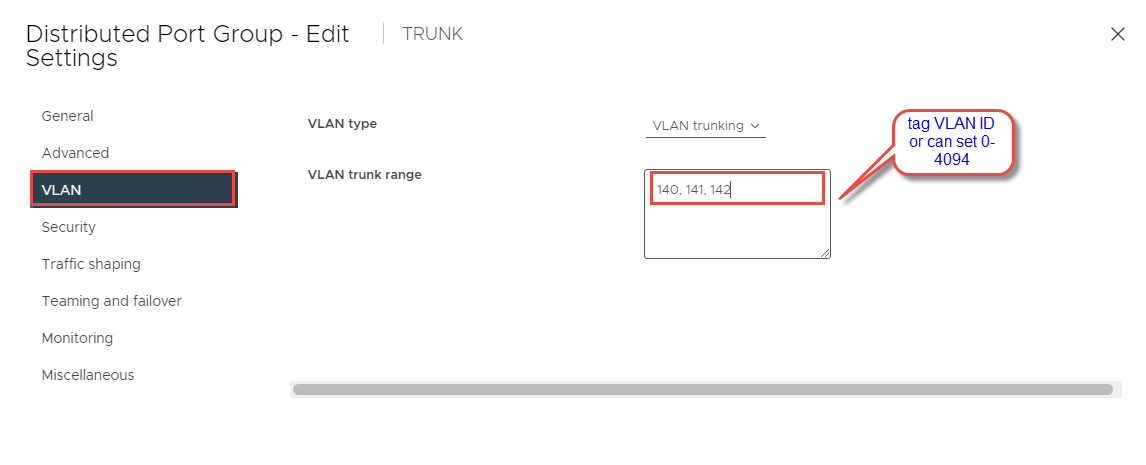
#### Bước 3: Cấu hình VLAN & Security cho TRUNK port <a href="#step-3-configure-vlan-and-security-for-trunk-port" id="step-3-configure-vlan-and-security-for-trunk-port"></a>

* Tag VLAN:<br>

  <figure><img src="https://content.gitbook.com/content/dOZ82gj0wvhbAUlxBHpj/blobs/AGB3BqQtGB1W8pCdj3Vs/image.png" alt=""><figcaption></figcaption></figure>

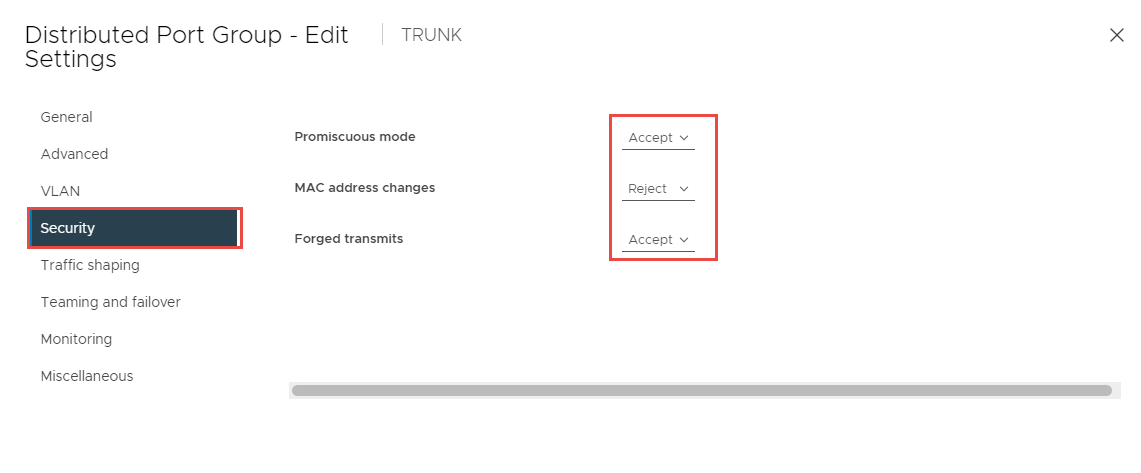
* Cài đặt **Security**: bật chế độ Promiscuous mode và Forged transmits.

  <figure><img src="https://content.gitbook.com/content/dOZ82gj0wvhbAUlxBHpj/blobs/0Fh0DhQvAhtEnex9gX8k/image.png" alt=""><figcaption></figcaption></figure>

{% endstep %}

{% step %}

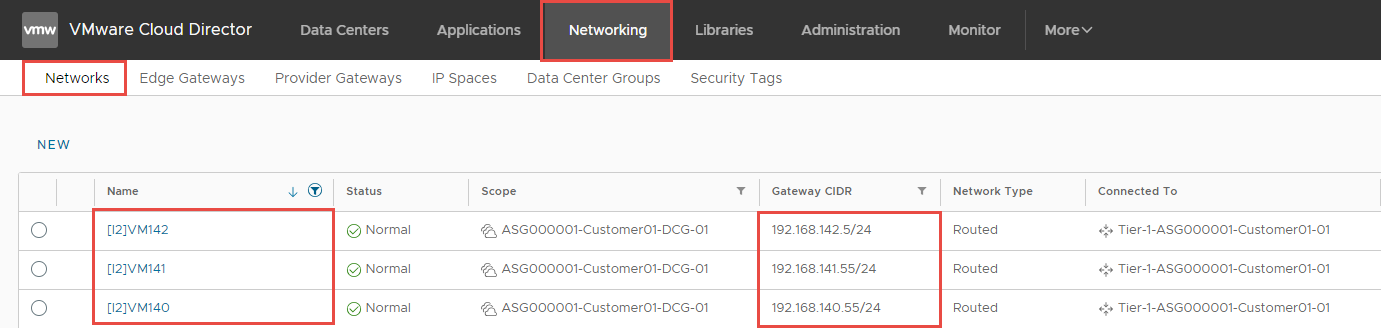
#### Bước 4: Tạo mạng trên HI GIO (các bước chi tiết có thể kiểm tra [tại đây](/hi-gio-user-guide-vn/network/1.-lam-viec-voi-mang-network/quan-ly-organization-vdc-networks.md)) <a href="#step-4-creating-network-on-hi-gio-detail-steps-can-check-here" id="step-4-creating-network-on-hi-gio-detail-steps-can-check-here"></a>

* Các mạng này được stretch layer 2 (cùng subnet như on-prem).
* Chọn IP cho gateway CIDR (**phải không trùng lặp địa chỉ IP**).

<figure><img src="https://content.gitbook.com/content/dOZ82gj0wvhbAUlxBHpj/blobs/MmG4kpFwN34vDNo5yqz0/image.png" alt=""><figcaption></figcaption></figure>
{% endstep %}
{% endstepper %}


---

# Agent Instructions
This documentation is published with GitBook. GitBook is the documentation platform designed so that both humans and AI agents can read, navigate, and reason over technical content effectively. Learn more at gitbook.com.

## Querying This Documentation
If you need additional information that is not directly available in this page, you can query the documentation by asking a question.

Perform an HTTP GET request on the following URL with the `ask` and `goal` query parameters:

```
GET https://docs.higiocloud.vn/hi-gio-user-guide-vn/hi-gio-draas/stretching-layer-2-networks-cho-hi-gios-draas/chuan-bi-cau-hinh.md?ask=<question>&goal=<user_goal>
```

`ask` is the immediate question: it should be specific, self-contained, and written in natural language.
`goal` is what the user is ultimately trying to achieve, the reason they need the answer. Sharing it helps GitBook give you a better, more relevant answer. A goal is most helpful when it describes the outcome the user wants rather than restating the question. For example, with `ask=how do I create an API token`, a goal like `automate deployments from our CI pipeline` lets GitBook tailor the answer to that use case.

The response will contain a direct answer to the question and relevant excerpts and sources from the documentation.

Use this mechanism when the answer is not explicitly present in the current page, you need clarification or additional context, or you want to retrieve related documentation sections.